Technically we have already been eating onions, parsley, coriander and dill from the garden, but this week we have had our first meals from our first hand sown vegetables - the courgettes, тиквички. I sowed two sorts back in April; one Bulgarian sort called Abundant hybrid, "изобилна" хибрид, and a heritage variety from Chiltern Seeds in the UK called Black Beauty Dark Fog. I should point out that all the courgettes that we've seen in Bulgaria are yellow and lightly coloured, and they tend to be harvested quite small. The larger courgettes in the photo of our first harvest below would definitely be classed as oversized by our neighbours!
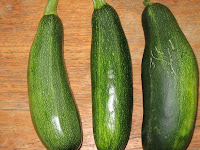
I am happy to report that the Bulgarian sort live up to their name and are big, sturdy and abundant producers. They are a nice texture, colour and flavour - even when they get 'too' big ;0) The heritage variety courgettes are both beautiful to look at and very flavoursome. They were a little later to flower then their Bulgarian counterparts, but I did plant them out a little later, but both sorts still have plenty of young vegetables and flower heads to come.
Despite giving half of this batch to a neighbour I still had over 9 pounds of courgette that I had to do something with, so following some salting guide lines below, I've made up my first jars of courgette slices to undergo lacto-fermentation (I hope). If that sounds a bit too scientific, it's the same process as traditionally used to make sauerkraut.
Generally, use 1.5% salt by weight of vegetables. The recipe in particular that I followed called for 2 tsp salt per 2–2 1/4 pounds of courgette. Another way of measuring this is to use 1 tsp = 6 g salt.
The end result is not particularly salty, and the liquor left in the jar is fabulous to use when cooking rice or salt, or in salad dressing, or drunk neat (I promise it's nice and very refreshing!)
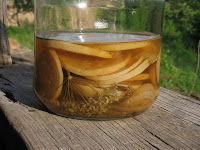
Before adding the courgette and salt, I put some chopped onion, quartered garlic clove, some dried dill and a dozen black peppercorns in the bottom of the jars. Here you can see what's left of a jar of lacto-fermented courgettes from our neighbour, plus heads of dill. I rather like the colouration of the liquor that comes from the peppercorns and other seasoning bleeding into the brine.
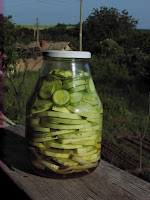
Here's the end result before leaving the jars in a cool, dark place to 'develop'. I'm not very good yet at packing in the courgette so that a) you get lots into each jar and b) more importantly, that the courgettes don't float and contact the air in the top of the jar - they need to stay submerged and away from air to avoid spoiling. Me thinks practice, practice, practice is the key here...
May I take this opportunity to wholeheartedly and enthusiastically recommend this book:
Preserving Food Without Freezing or Canning: Traditional Techniques Using Salt, Oil, Sugar, Alcohol, Vinegar, Drying, Cold Storage, and Lactic Fermentation by The Gardeners & Farmers of Terre Vivante (with a new foreword by Deborah Madison), Chelsea Green Publishing Company. Not only is it very varied, very practical, very interesting but it's also full of gorgeous pencil drawings that I'd love to emulate one day.
Another book that literally had me drooling whilst reading it (yes, cover to cover during winter when the garden was just a far off dream...) is:
Wild Fermentation: The Flavor, Nutrition, and Craft of Live-Culture Foods by Sandor Ellix Katz (foreword by Sally Fallon), Chelsea Green Publishing Company. Yoghurt, cheese, beverages, sourdough and some more exotic things like misos and kimchis are included in this one, yum yum yum.
We'll have a lot more courgettes on our hands imminently - even more imminently now, it's just been thundering and raining, and that means a growth spurt - so I want to try the drying-slices-on-a-string-in-the-sun and the vinegar and oil recipes, also from the Terre Vivante book.
Next on the preserving agenda is to start preparing jars of cucumber pickles and vine leaves, and later in the season green beans, and of course tomatoes, and okra, peppers... watch this space :O)
 I'm delighted to say that I've been able to collect my first 200-odd chickpea seeds (picture right, and centre below) - нахут, or леблебия (a nod to Turkish here I think) - having nursed my approx. 50 chestnut chickpea seeds, bought last year, through to maturity. I still have most of the plants to harvest - they have some green leaflets left to wither first - so I am hoping to top 500 decent seeds for saving and resowing, and possibly even eating. This project has been a real pleasure (if a little nerve wracking at times; I've had to rush out and cover them several times to stop them getting battered by heavy rainfalls) and they are beautiful plants.


