Wednesday, 9 January 2013

Christmas projects

On a change of subject, I have recently completed two pillowcase projects for my neighbours as Christmas 2012 gifts. I began knitting the edgings in May 2012, which was continued on and off over the autumn. I attached these to the pillowcases in quiet moments throughout December (yes, I left it to the last minute...) whilst keeping warm by the fire.

Here's the end result:
 And a detail of the leaf edging:

Besides cotton, as above, I knitted wool socks and a cuddly rabbit in 2012 and a polo-neck jumper (nearly finished). Pictures to follow another day.

Wednesday, 25 January 2012

Me 1: moles nil


At last, I've done it. I've dug up the first two of sixteen Jerusalem artichoke plants that I've been nervously, impatiently, intriguedly watching over since mid-January 2011 when I planted some purchased tubers.

It didn't take long after planting for the first mole hills to appear in and around the bed, so I thought then that I'd probably never see any young plants, let alone new tubers. S-l-o-w-l-y, little green shoots started pushing up in all the places where I put a tuber, so I breathed a sigh of relief.

What impressive plants! Despite a hot summer, some torrential downpours, some very strong winds etc., they remained upright and got easily to eight feet tall. Multitudes of flower buds appeared later on and the yellow flowers that resulted were very cheerful; the bees rather enjoyed them too. Having got that far, I was again hopeful of getting a crop and I was itching for the first frost to arrive and the foliage to die back. And then the mole hills returned. Lots of them.

That was long ago and I've since been sidetracked, but I've got the fork out a couple of times now and have ended up with these beauties.

No sign of teeth marks either, or any empty voids (as with my carrots, grrrr). The skin looked so thin that I didn't peel these (plus I'm lazy! Judging by the knobbles I'd be there for ages). I've tried a Turkish recipe with rice – yummy. The skin wasn't unpleasant at all, just required a bit of chewing and, after all, fibre's good for us. My second 'recipe' was mashed Jerusalem artichoke and potato with a bit of yoghurt added and that was very enjoyable too. I'm really looking forward to eating the tubers from the other plants, minus a few good ones with a lot of eyes for next year's patch. I just hope the moles stay away…

Srebarna nature reserve


I am so overdue in posting this! Today's a miserably wet day, with snow due later on, and I've found myself thinking about a lovely - dry - day out that I had in November. Well, better late than never... 

I've been for a day trip! It was a lovely sunny day, although a bit nippy if you kept still for too long. Our destination was the Srebarna reserve, situated on the banks of the Danube – if we'd have walked a bit further around (and if it was a bit clearer) we could have waved at Romania. (In fact we did wave once we got to the city of Silistra after lunch). It was lovely to stretch our legs and nose about a bit. Dad was visiting and he discovered many snake egg nests. We spotted a few white egrets on our walk, but the best bit was listening to the thousands of geese. We didn't make it round to get a close look at the birds, though we'll return another day. I'd love to go and see the pelicans that Srebarna is famous for! The spiky acacia along the paths were quite something too, yikes. The orange, mealy sea buckthorn berries were also ripe at the time, so I'll try my luck at germinating the small handful that I collected.

Here's some extra info: http://whc.unesco.org/en/list/219
 

Definitely worth a visit.
P.S. Those little specks on the lake above are a LOT of geese coming back in to land.

Monday, 29 August 2011

Jewels!

Introducing the Bulgarian pepper (чушка) - one of many anyway - and what a wonderful vegetable it is too. This sort is called капия, that is, pointy. Seeing piles and piles and rows and rows of these at the market is a delight, especially in the sunshine; they're so bright and shiny like jewels - and smell superb too - that they induce a feeling of happiness, but maybe that's just me! Having recently purchased 25 kg of these peppers, we had a day full of roasting, skinning and preserving yesterday. Ideal winter food, let me tell you :O) Stew, pasta, filled pastry, salad, soup... versatile and yummy.


Moving on to some more jewels, now is the time to be harvesting cornelian cherries (дренки), from the cornelian cherry tree (дрян), or Cornus mas. I first came across this tree (or shrub) in Uncommon Fruits for Every Garden by Lee Reich, Timber Press. The line drawings in this are very accurate, so much so that I immediately recognised the mystery tree that was behind the house (back then in a thicket of plum trees). It turned out that there are two bushes just by the front gate too, as well as about a dozen baby to juvenile trees all across the garden! Not only is it beautiful in Spring, with it's profusion of yellow flowers when there's not much other colour about, it's interestingly veined leaves throughout Summer add to its charm, along with these ruby red fruits of course, and finally, in winter, it's an unusual plant for already having its buds formed (and, for this reason, they're used in Christmas baking as a charm - the number of buds foretells your fortune for the coming year).
Back to the present, I'll be harvesting our cornelian cherries throughout this week, for proper 'dealing with' next weekend. But a word to the wise! They may look red and ripe and lovely, but it's very easy to get a shockingly sour one, and astringent to boot!!! In fact, most of the people I know don't eat them raw, and if they do then it's only after they've been picked and laid out in a single layer in a cardboard box for several days, to allow the sugars to develop a bit more (so I'm told). They also turn much deeper in colour, very dark and rich. Last year I made some sweet cornelian cherry 'marmalade' (a runny jam really but great on waffles), savoury Georgian shindis satsebeli sauce and I also dried, a bit too thoroughly, what was left over - lovely in pilafs and stuffed marrow or pumpkin.

Having mentioned Uncommon Fruits, I should also report that it features several other plants of interest that are present in Bulgaria. I was reading through it one day, put it down, then a little later went for a wonder on the track just outside the house. I'd been admiring a flowering bush in the garden of the abandoned house opposite and went to take a closer look. I though "That looks familiar" and, lo and behold, there was a mature clove currant (Ribes odoratum). Top features include it's vanilla and clove scent, apparently edible berries (like black currants) and great trumpet-shaped flowers (far bottom). Several of these have since turned up in the garden, yay. Not so good is that the goats have managed to eat most of them, but I have a few left!! As far as I know, none have ever flowered yet, though they do have to reach a certain size/age to do so. Next Spring? Last but not least, a plant that I know grows in Bulgaria, and whose fruits definitely get collected, is the medlar (мушмула). Apart from buying a bag full of these fruits from the local market last autumn I've not come across them outdoors, but frankly I've not looked very hard. I do want a medlar or two in the garden eventually so an outing to the local woods, which are just a few minutes from the house, should be mounted in the not too distant future I hope!

Saturday, 27 August 2011

Something on seeds

As I've been spending a fair amount of my 'free' time working on saving seeds from the garden of late, I thought I'd show you the fruits of my labour, thus far anyway.

I'm delighted to say that I've been able to collect my first 200-odd chickpea seeds (picture right, and centre below) - нахут, or леблебия (a nod to Turkish here I think) - having nursed my approx. 50 chestnut chickpea seeds, bought last year, through to maturity. I still have most of the plants to harvest - they have some green leaflets left to wither first - so I am hoping to top 500 decent seeds for saving and resowing, and possibly even eating. This project has been a real pleasure (if a little nerve wracking at times; I've had to rush out and cover them several times to stop them getting battered by heavy rainfalls) and they are beautiful plants.

Also quite newly saved from the garden are a good number of sugar snap peas (r - pea is грах but I'm not sure how the 'sugar snap' is described here), dried broad beans (l - бакла) and green beans (far bottom- боб) of assorted colours, the latter two being generously given to us by different neighbours.

That covers food seeds for now, but I have also been collecting mature seeds from my sweet pea Matucana - which I thoroughly recommend for their beautiful, almost glowing, deep pinky purple and mauve flowers - as well as pot marigold (невeн), a small amount of peony (божур) seed from the big peony we found in the garden, an overabundance of soapwort (сапунче) and, much earlier this year, plenty of fritillary seeds.


Tuesday, 16 August 2011

New arrivals - Onk!

Having gone quiet on you for a long, long time, I most definitely need to pull my socks up and tell you about some things going on here recently. To get things going again, I must introduce my new feathered friends: our three lovely geese.

Please meet Enoch (m - centre, about to have a nice head and neck wash), Biscuit (f - left, with a fabulous bouffant up top!) and Noodle (f - right, being ladylike and also keen for a wash).

We've had these dears for a bit over a fortnight now and they seem to have settled in. They've been grazing up and down the 'wilder' area, and generally having a sit in the shade, watching the world go by and preening. Amusingly, the like to loiter near to the goats and if the geese are out first in the morning they go and search for their cloven-hoofed friends.

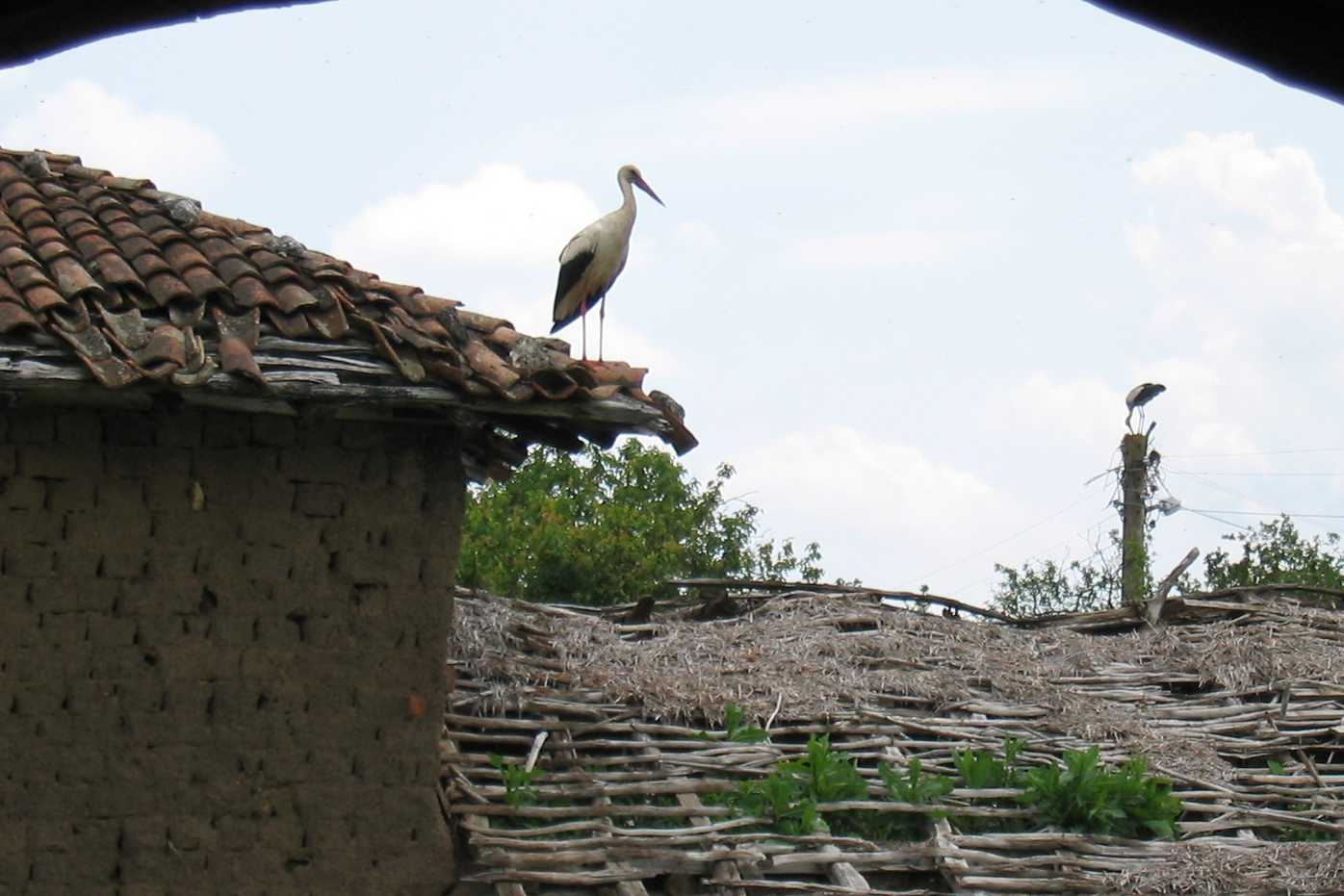
Having been rather quiet at first they are all a bit more vocal now - much to my delight as I love goose noises! - especially when the young stork, or its parents, fly over back to the nest. So there's hope yet for them being good guard geese. The girls in particular were a bit wary on the first couple of days but now all three waddle over when they see a human with watering can or food. They're all characters and last night we discovered that they love watermelon :O)

Thursday, 14 April 2011

A colourful first

For at least the last two Springs, the big, old apricot tree at the back of the house has sported only leaves. No surprise really as the preceding winters for those two years were particularly cold but this Spring we've been treated to a beautiful covering of blossoms, which smell particularly good too, mmmmm.


We may even be in luck and have a second 'proper' apricot in the garden, though we were told by the neighbours it was like an apricot but had smaller fruit - however, this was when we knew very little Bulgarian, so perhaps it's simply a tree with less impressive edibles? I eagerly await some fruit setting (the bees seem to be doing their bit).

Fingers crossed that the current, shall we say boisterous, rain and wind leaves some blossom on the tree for long enough to get to that point!

Monday, 28 March 2011

Here at last - welcome Spring

Happy Spring! I think it's now safe to say that Spring has arrived in our corner of Bulgaria. There hasn't been any snow for a few weeks now and green is spreading across the hillside, and most welcome it is too. The crocus bulbs that I popped in last autumn have been treating us to a show of white, purple and glowing orange (thank you Mum!) and I've been without a coat and/or jumper working in the garden (so much to do...).

I've spotted my first three storks of this year flying over the house last weekend, so I've hung up my martenitsa on a young apple tree near the house. Fingers crossed that we'll have another stork pair make use of the nest that was built here last year (though Mr. Stork flew off with another female and Mrs. Stork eventually gave up sitting and flew off too); I hope we see little 'uns this time.

Speaking of little 'uns, I may become a 'grandma' in April and May! Our goats Yo (grey and white) and Yammy (white with horns) are due to kid either side of Easter; Yo is definitely with kid but Yammy's keeping us guessing (one day big belly, next day small).


We're overflowing with eggs at the moment, both chicken and turkey eggs. Today's count was ten, and judging by the size of a couple of them we may have double yolkers. I'm happily trawling through the recipe collection for ways to use these, yum yum.

Over winter I bought a selection of seeds to continue adding plants that I love to the garden, amongst which were two packets of sweet violet (Viola odorata): one wild, one a cultivar. It remains to be seen how much luck I'll have with these, but I was delighted to discover a generous patch of violets - and how gorgeous they smell too - down by the washing line yesterday.

Now that I've awoken from hibernation (!) I'll be back more often to share the goings on here.
P.S. this post is dedicated to Ro, thanks for the prod!

Monday, 2 August 2010

Happy Swiss National Day

All right, I'm a day late now as the Swiss National Holiday is on August 1st every year, but I was busy celebrating yesterday.

In honour of the day I made two Swiss recipes: Schaffhausen onion quiche (bottom) and Lenzburger apple pie (top), yummy.

Both recipes came from the wonderful little booklet "Baking with Swiss farm women" published by the LID agricultural information center of Switzerland. It features 27 savoury and sweet recipes, one from every Swiss canton, and I thoroughly intend to make them all one day. I got my copy free from the following url:
http://www.agriculture.ch/en/shop/
so if you're interested I recommend you head over there.

I must say that I was surprised at how well the two lots of pastry turned out! It was another 30ºC+ day and I was HOT, so needless to say that the butter and working area weren't nice and cool as is befitting for pastry making. The result was still lovely, flaky and crisp so I must have had a bit of luck there. 

My only changes were to use thick yoghurt and smetana (сметана, like thick, creamy, almost clotted yoghurt), in place of cream as it's very difficult to find here and I added a bit of fresh dill to the onion quiche. I used ground almonds instead of ground hazelnuts for the apple pie and sprinkled some on top in place of slivered almonds too. These were divided into nine pieces and we then went visiting to our nearest neighbours so they could enjoy the day as well. So far the reactions seem to be good :O)


After our tour of the neighbours, there was just enough time to get my Bern (my grandma's canton) and Swiss flag lanterns up in the garden and enjoy looking at those with a cup of hot chocolate as the light faded, until the mossies forced us back indoors.

Sunday, 20 June 2010

Some new arrivals

In early June two storks (and I swear three at times) started taking an interest in the telegraph and electricity poles in front of our house and along our 'street' (in reality a grass track which is the access route for the six properties along it). I was rather surprised because most of the storks flew by weeks and weeks ago having returned from further south; one neighbour says from Egypt specifically. I think this was a young pair as it was so late to start nest building, and subsequent watching seems to have proved this!


They certainly took their time getting started, having finally selected the electricity pole in front of our derelict house in the garden. Enjoyably, we can see the pole, nest and storks from out upstairs landing, or chardak, чардак. For days all I saw was one stork, all alone, standing on the pole. Rarely, the other stork would return and the pair would clack beaks and spend a few hours picking up occasional sticks. Having got to the dozen or two dozen stick stage, it would unfortunately rain and all the sticks would fall off, amateurs! Repeat of the above, about four times over.

 On the fifth attempt the sticks must have got past critical mass and a proper nest, that resisted subsequent rain, started to grow, hooray. Both storks were around from now on - one wonders if the other stork had it's eye on a different location and there was a bit of a stand off for a while before building commenced here! - and whilst working in the garden a big, black shadow often went over head, fetching and carrying material. (Worth clicking on this one to see it a bit larger!)

Both storks have been helpfully tidying up the garden by picking up tree and scrub cuttings from past week's work outdoors. They are a striking sight wading through the grass and testing their sticks with a shake of the beak! Not quite as majestic as when they are stood on the nest or flying, but impressive nonetheless.


As you can see, the nest is a decent size now, and Mrs Stork has taken to sitting down for a few hours at a time. Hopefully the eggs will be soon to appear and Mrs Stork will sit tight. I am slightly concerned that after all this effort and rebuilding it might still all come to nothing... whenever rain is approaching or the wind gets up both birds disappear until better weather returns. Please let the eggs stay warm enough and develop. I'll keep you posted :O)

First harvest


Technically we have already been eating onions, parsley, coriander and dill from the garden, but this week we have had our first meals from our first hand sown vegetables - the courgettes, тиквички. I sowed two sorts back in April; one Bulgarian sort called Abundant hybrid, "изобилна" хибрид, and a heritage variety from Chiltern Seeds in the UK called Black Beauty Dark Fog. I should point out that all the courgettes that we've seen in Bulgaria are yellow and lightly coloured, and they tend to be harvested quite small. The larger courgettes in the photo of our first harvest below would definitely be classed as oversized by our neighbours!

I am happy to report that the Bulgarian sort live up to their name and are big, sturdy and abundant producers. They are a nice texture, colour and flavour - even when they get 'too' big ;0) The heritage variety courgettes are both beautiful to look at and very flavoursome. They were a little later to flower then their Bulgarian counterparts, but I did plant them out a little later, but both sorts still have plenty of young vegetables and flower heads to come.
Despite giving half of this batch to a neighbour I still had over 9 pounds of courgette that I had to do something with, so following some salting guide lines below, I've made up my first jars of courgette slices to undergo lacto-fermentation (I hope). If that sounds a bit too scientific, it's the same process as traditionally used to make sauerkraut.

Generally, use 1.5% salt by weight of vegetables. The recipe in particular that I followed called for 2 tsp salt per 2–2 1/4 pounds of courgette. Another way of measuring this is to use 1 tsp = 6 g salt.

The end result is not particularly salty, and the liquor left in the jar is fabulous to use when cooking rice or salt, or in salad dressing, or drunk neat (I promise it's nice and very refreshing!)

Before adding the courgette and salt, I put some chopped onion, quartered garlic clove, some dried dill and a dozen black peppercorns in the bottom of the jars. Here you can see what's left of a jar of lacto-fermented courgettes from our neighbour, plus heads of dill. I rather like the colouration of the liquor that comes from the peppercorns and other seasoning bleeding into the brine.

Here's the end result before leaving the jars in a cool, dark place to 'develop'. I'm not very good yet at packing in the courgette so that a) you get lots into each jar and b) more importantly, that the courgettes don't float and contact the air in the top of the jar - they need to stay submerged and away from air to avoid spoiling. Me thinks practice, practice, practice is the key here...

May I take this opportunity to wholeheartedly and enthusiastically recommend this book: Preserving Food Without Freezing or Canning: Traditional Techniques Using Salt, Oil, Sugar, Alcohol, Vinegar, Drying, Cold Storage, and Lactic Fermentation by The Gardeners & Farmers of Terre Vivante (with a new foreword by Deborah Madison), Chelsea Green Publishing Company. Not only is it very varied, very practical, very interesting but it's also full of gorgeous pencil drawings that I'd love to emulate one day.

Another book that literally had me drooling whilst reading it (yes, cover to cover during winter when the garden was just a far off dream...) is: Wild Fermentation: The Flavor, Nutrition, and Craft of Live-Culture Foods by Sandor Ellix Katz (foreword by Sally Fallon), Chelsea Green Publishing Company. Yoghurt, cheese, beverages, sourdough and some more exotic things like misos and kimchis are included in this one, yum yum yum.


We'll have a lot more courgettes on our hands imminently - even more imminently now, it's just been thundering and raining, and that means a growth spurt - so I want to try the drying-slices-on-a-string-in-the-sun and the vinegar and oil recipes, also from the Terre Vivante book.

Next on the preserving agenda is to start preparing jars of cucumber pickles and vine leaves, and later in the season green beans, and of course tomatoes, and okra, peppers... watch this space :O)

Sunday, 13 June 2010

And 'cooler' still

To follow on from my last post, having gone from the current high temperatures back to Spring's relative coolness, let's now plunge back into the Winter just passed.

It is true to say that I  have never experienced so much snow, nor so much cold, before. We had a very mild autumn - or as they call it here a Gypsy summer, циганско лято - and then a late arrival of the snow, so we weren't expecting the thermometer to read -28ºC in late January! What a first winter, especially with gappy ceilings and a draughty roof, but we sat it out.

Much to our neighbours' amusement I was out with the camera quite a few times taking pictures of the snow - well it is rather novel to me, I'm sure it'll wear off in the end. For your enjoyment here are a few.

Here's one of my favourites (above): we had a wee bit of rain in mid January, followed by a drop in temperatures to a more normal -12º or so. When I woke up in the morning I did have to blink a few times before I believed what I saw, and heard. EVERYTHING was surrounded by 2–3mm of ice and I mean everything.


There is a huge and very old walnut tree in front of our house, and that too was swathed in its ice blanket. As I was enjoying the sight, as it was just getting light, there was a gentle bit of breeze, and then there was an unnervingly audible, very curious and impossible to ignore 'song' from all the limbs and branches as the ice creaked as they flexed. It was very hair raising!

Later in the day the wind got up and I stayed well, well clear of that tree, and all the others - with that much weight up there and the travel those cracked and gnarled old branches were making it wasn't worth the risk. There's a sound I will never forget.

And that wasn't all, the following day was a wee bit milder too, so we ended up with everything covered by 2mm of ice plus some very pretty, pure white hoar frost. Above is the larger of our two mulberry trees. Thankfully mulberries are very late to go into leaf and bud in Spring so they were none the worse for this rough treatment. It remains to be seen if we'll get any mulberries this year but the clearing away of scrub from around them can only but help as they are wind pollinated.

Something a little cooler

Greetings,

It occurs to me that until I get into the habit of updating to this blog I will be inexcusably slow and infrequent to post. So, in an attempt to stave of those guilty feeling I'll have for not writing for so long (last post March 25th, oh dear) may I offer out a blanket apology for being inconsistent/unreliable/quiet, and if you'll allow an uncharacteristic Americanism, tardy ;O) That should lighten my shoulders for a few posts at least so thank you for your indulgence, and now let's continue...

It's been hovering around 32ºC here during the day for the past several days, and if the forecast is to be trusted will continue like this for another week. For a pale, fair haired, fair skinned female not used to much heat I've been casting my thoughts to earlier this Spring when things were that bit cooler. Here's what it was like when the garden was waking up and I didn't yet need factor 50+ sun lotion and a hat to be able to work outside.

Above, here's our view from upstairs down towards the village. Taken just after the abundant mud had re-solidified and the hillside greened up. It wasn't long before the buds started swelling and the birds started twittering - very welcome sights and sounds after a winter that hit -28ºC (and more about that later folks).

Here are some welcome, sunny daffodils from my neighbour, plus some willow sprigs from the local, impermanent stream, currently running thanks to the snow melt.

The hazel bush is off to a slow start but here come the leaves and more catkins.

I wish you could smell these lily of the valley flowers and zdravets - здравец - leaves. Clean, sweet, a little spicy and pleasantly pungent. Zdravets plants, properly Geranium macrorrhizum or scented cranesbill, have long had a special place in Bulgarian folk lore. Giving of a bunch of zdravets to someone is a symbol of good wishes and goodwill, and offers protection to those setting out to travel or engaging an import undertaking (from Mercia Macdermott's Bulgarian Folk Customs which I highly recommend to those who are interested).

It seems like long ago now, but the cherry blossoms were a lovely part of Spring. Now we have almost ripe cherries on the tree that we hope to make into juice for winter. That is, if the woodpecker and his pals leave us any! With a bit more pruning and TLC we should have an even better fruit set next year.

I'd love to have a Morello cherry, or six :O) in the garden one day, just like grandma used to have. There was nothing so nice as a big spoonful of Mama's morello cherry jam, mmmmmm.

Thursday, 25 March 2010

Why chicory and cucumbers?

When I first arrived in the village in early July 2009, having bought an old property in the countryside in north-east Bulgaria, packed up all my worldly goods, left the UK and moved here to start a new life, the roadsides were embellished with bright and numerous blooms of chicory flowers.
I have never knowingly seen these in England, and with the way the flowers 'popped' from the green verges they made a welcome and lasting impression. Through the first summer and autumn I have been here, and even into December, these flowers have been a constant companion.

I have often heard that chicory has an edible root which may be used as a coffee substitute when roasted and ground, something I have always fancied trying. A timely leaf crop may also be had from chicory and its siblings when forced over winter, again something I plan to try. A project for the garden this year is to encourage some wild and seed-grown chicory plants and the do some experimentation! 

 My arrival here was shortly followed by the beginning of the cucumber season. Hot weather, sun and an abundance of cucumbers (and tomatoes and melons and peppers and many more lovely veg) also served to remind me that I was not in England any longer, especially whilst savouring a delicious bowl of tarator (таратор), a Bulgarian speciality which is a cold summer soup made of yoghurt, cucumber and garlic (lots!). Just what you need when the temperatures top 25ºC. Having consumed many, many bowls of this highly recommended dish - mostly prepared by my generous and friendly neighbour - this too made a strong impression on me and chicory and cucumbers together serve as a suitable focus of why I'm here and what I hope to be up to...